
Regulation Before Instruction: Why De-escalation Skills Matter for Teachers and Parents
During my time as a Site-Based Induction Specialist and mentor teacher, one of the most consistent gaps I observed in new educators was not content knowledge, lesson planning, or even curriculum pacing. It was the lack of preparation for behavior de-escalation and emotional regulation. Many new teachers entered classrooms without the skills to help students calm their bodies, process emotions, and return to learning. Some were still developing their own regulation strategies, which made high-stress situations even more challenging.
When regulation supports were missing, classroom management became reactive rather than instructional. Power struggles increased. Instructional minutes disappeared. Teachers felt burned out, and students, especially those with disabilities, lost meaningful access to learning.
This disconnect matters legally as well as educationally. Under the Individuals with Disabilities Education Act (IDEA), when a child’s behavior interferes with their learning or the learning of others, the IEP team is required to consider and implement positive behavioral interventions and supports (20 U.S.C. § 1414(d)(3)(B)(i)). In other words, regulation and de-escalation strategies are not optional. They are a component of providing a Free Appropriate Public Education (FAPE).
A Dysregulated Brain Cannot Learn
Research consistently shows that emotional dysregulation directly impacts attention, working memory, and cognitive flexibility. The Harvard Center on the Developing Child explains that stress responses activate survival regions of the brain, limiting access to higher-level thinking and problem-solving. When students are overwhelmed, their brains are simply not available for instruction.
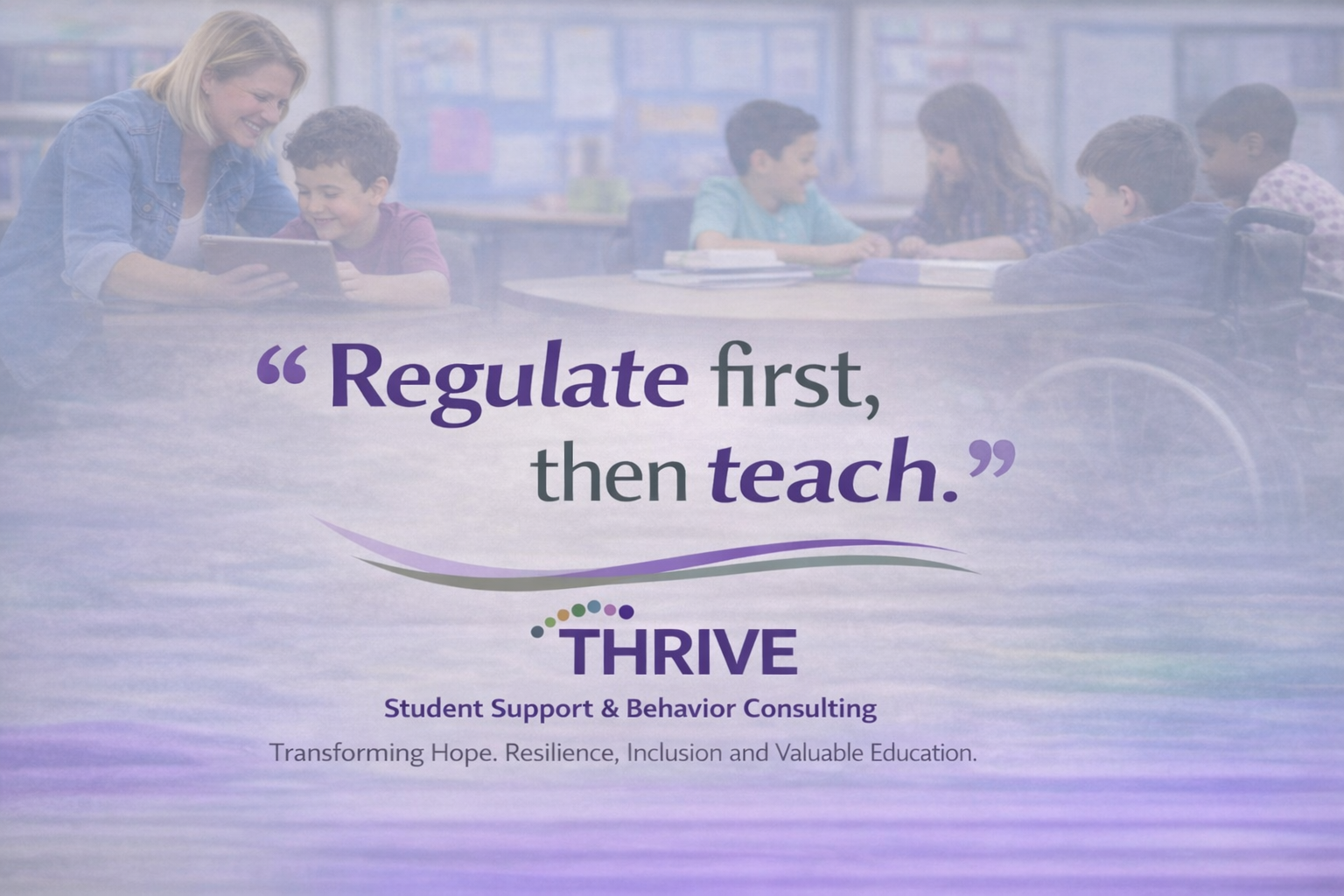
This is why “teach first, manage later” does not work. Regulation must come before instruction. Addressing behavior without addressing emotional state often escalates situations rather than resolving them.
Structure Is a Regulation Tool, Not a Control Mechanism
Predictable routines, visual schedules, and consistent expectations reduce anxiety and prevent escalation. The PBIS Technical Assistance Center emphasizes that proactive structures and explicit teaching of expectations significantly reduce problem behavior while increasing academic engagement.
These same principles translate directly to home. Consistent morning routines, predictable homework expectations, and clear transitions provide children with a sense of safety, which lowers emotional reactivity and improves cooperation.
Self-Regulation Is a Skill That Must Be Taught
Self-regulation is not a personality trait or a matter of compliance. It is a learned skill. The CASEL framework identifies self-management and self-awareness as core competencies that require direct instruction, modeling, and practice.
Similarly, Understood.org highlights that many behaviors commonly labeled as “defiance” are actually signs of executive functioning challenges, including difficulty with emotional control, task initiation, and flexibility. Teaching strategies such as breathing techniques, movement breaks, requesting help, or using a calm-down space equips students with tools they can use across settings.
Connection De-escalates Faster Than Consequences
Strong relationships are one of the most effective behavior supports available. The National Association of School Psychologists (NASP) emphasizes that consistent, relationship-based approaches across school and home environments increase regulation and reduce repeated behavioral incidents.
This is also echoed in guidance from Wrightslaw, which reinforces that behavior should be understood as communication. When adults focus on understanding the function of behavior rather than controlling it through punishment, students are more likely to develop lasting self-regulation skills.
Why This Matters Across School and Home
When teachers are equipped with regulation and de-escalation strategies, classrooms become places of learning rather than crisis management. When parents use similar approaches at home, children experience consistency, predictability, and emotional safety. That alignment is critical for students with disabilities and beneficial for all learners.
IDEA does not require perfection, but it does require thoughtful, data-informed supports that allow students to access instruction. Regulation is foundational to that access. Without it, behavior escalates, instruction stalls, and progress is limited. With it, students build skills that extend far beyond the classroom and into lifelong success.