
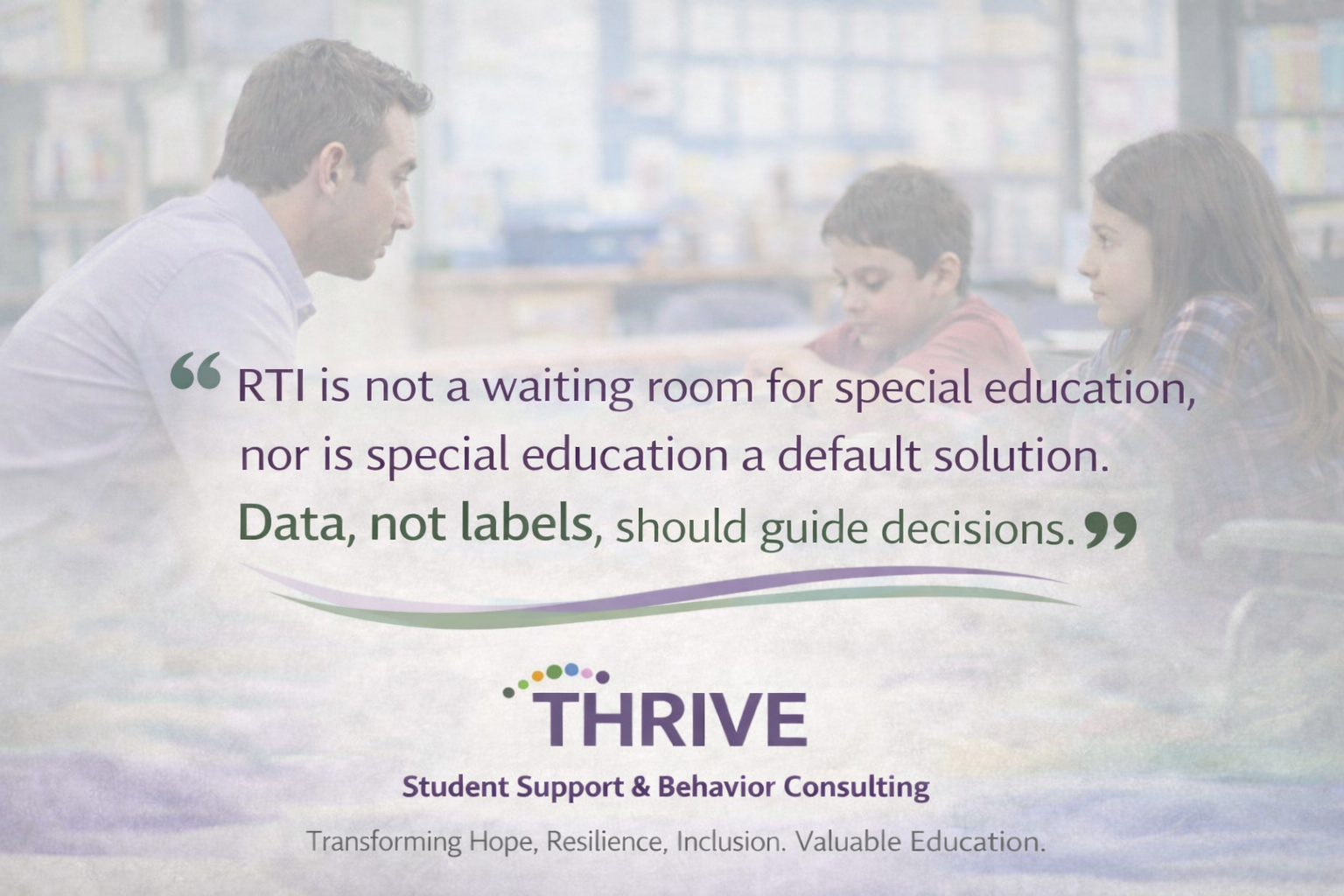
RTI, Progress, and Placement: Let the Data Lead the Decision
Response to Intervention (RTI) was designed to be a preventive, data-driven framework, not a fast track to special education. Federal law requires states to have policies and procedures in place to ensure that all children with disabilities are identified, located, and evaluated, while also preventing inappropriate identification (IDEA §300.111). RTI exists within that balance, supporting students early while ensuring decisions are based on evidence, not assumptions.
When RTI is implemented with fidelity, it helps schools determine whether instructional adjustments within general education are sufficient or whether a student may need more intensive support. The issue arises when progress data is misunderstood or ignored, particularly when students who are making measurable gains are referred for special education evaluation without a defensible rationale.
When a Student Is Making Progress in RTI
If a student is participating in RTI and progress monitoring data shows a clear upward trend, this indicates that the current level of instruction and intervention is effective. Federal regulations governing specific learning disability identification explicitly require teams to consider whether the student demonstrates insufficient progress when using a process based on response to scientific, research-based intervention (IDEA §300.309(a)(2)).
If the student is making progress, the criteria for referral are not met.
Guidance from the IRIS Center reinforces that RTI data should be used to determine responsiveness, not to justify escalation when the system is working as intended. When progress monitoring demonstrates consistent growth, continuing RTI is not a delay of services, it is the appropriate instructional response.
Referral for evaluation should not be driven by impatience, staffing constraints, or the belief that special education is inherently “more supportive.” IDEA requires eligibility determinations to be based on multiple sources of data and evidence of a disability that adversely affects educational performance, not simply academic struggle at one moment in time.
When RTI Data Signals a Need for Evaluation
RTI data becomes legally and educationally relevant when a student’s progress flatlines or regresses, despite appropriate, research-based interventions implemented with fidelity. IDEA §300.309 requires teams to examine data demonstrating that the student’s rate of improvement is insufficient to meet age- or grade-level standards.
However, even in these cases, teams must first consider whether:
-
Interventions were delivered as designed,
-
Instruction was matched to the student’s identified skill deficits,
-
Progress monitoring was frequent and reliable,
-
Environmental or attendance factors impacted outcomes.
RTI may not be used to delay or deny an evaluation when a disability is suspected, but it also may not be used to justify evaluation when the data does not support that conclusion. Both actions violate the intent of IDEA.
LRE Must Be Determined by Need, Not Program Labels
A persistent misunderstanding in schools is the assumption that special education placement automatically represents a less restrictive or more supportive environment. IDEA directly contradicts this assumption.
The Least Restrictive Environment (LRE) provision requires that students with disabilities be educated with nondisabled peers to the maximum extent appropriate, and that removal from general education occurs only when education in that setting cannot be achieved satisfactorily with the use of supplementary aids and services (IDEA §300.114(a)(2)).
If a student is making meaningful progress in RTI within general education, particularly with small instructional groups and targeted interventions, removing that student solely to access special education services may increase restrictiveness, not reduce it.
In practice, RTI settings often have intentional caps on group size to support individualized instruction. Special education intervention settings, however, are not federally capped by ratio. As a former special education teacher, I have taught reading intervention classes with up to 27 students, supported by one paraprofessional. Much of my instructional time was devoted to compliance tasks such as progress monitoring IEP goals, leaving limited time for actual instruction. In such cases, placement alone does not guarantee increased instructional intensity.
Under IDEA, LRE decisions must be individualized, reviewed annually, and grounded in student-specific data, not assumptions about service type or staff credentials.
Intervention Does Not Equal Special Education
Another frequent point of confusion is the belief that an intervention becomes special education simply because it is delivered by a special education teacher. IDEA makes a clear distinction.
Special education requires:
-
Eligibility under IDEA,
-
An Individualized Education Program (IEP),
-
Specialized instruction designed to meet the unique needs resulting from a disability (IDEA §300.39).
An intervention, even when delivered by a highly trained educator, remains a general education support unless it is provided pursuant to an IEP. Research institutions such as Peabody College emphasize that RTI exists to improve instruction and outcomes before disability identification, not to replace special education services when a disability is present.
Data, Not Labels, Must Drive Decisions
IDEA does not require teams to place students in special education because services are available, nor does it permit teams to withhold evaluation when data supports concern. The law requires thoughtful analysis, ongoing progress monitoring, and individualized decision-making.
If RTI data shows an upward trend, remaining in RTI may represent the student’s least restrictive environment. If data shows stagnation or regression despite appropriate intervention, evaluation may be warranted. The determining factor is not the tier, the teacher, or the label, it is the student’s response to instruction over time.
When schools allow data to guide decisions rather than assumptions, RTI and special education function as intended: complementary systems designed to meet student needs, protect access to instruction, and ensure compliance with IDEA.