
Teaching the Way Children Learn: A Systems Question for Educational Leaders
“If a child can’t learn the way we teach, maybe we should teach the way they learn.”
— Ignacia Estrada
This quote isn't a feel-good philosophy, but a call to examine the systems we build for children.
For educational leaders, this is not an individual teacher issue. It is a systems question.
When large numbers of students are disengaged, dysregulated, or demonstrating challenging behavior, the pattern matters. These are not isolated failures of motivation or discipline. They are often signals that instruction is misaligned with development, context, and learner variability.
Too often, the response is to increase compliance demands, intensify consequences, or move students along a continuum of placements until “general education inclusion” is treated as the ultimate destination. Inclusion matters. Access matters. Belonging matters. But inclusion in name only, without instructional alignment, is not equity.
Inclusion Is Not the End Goal. Access Is.
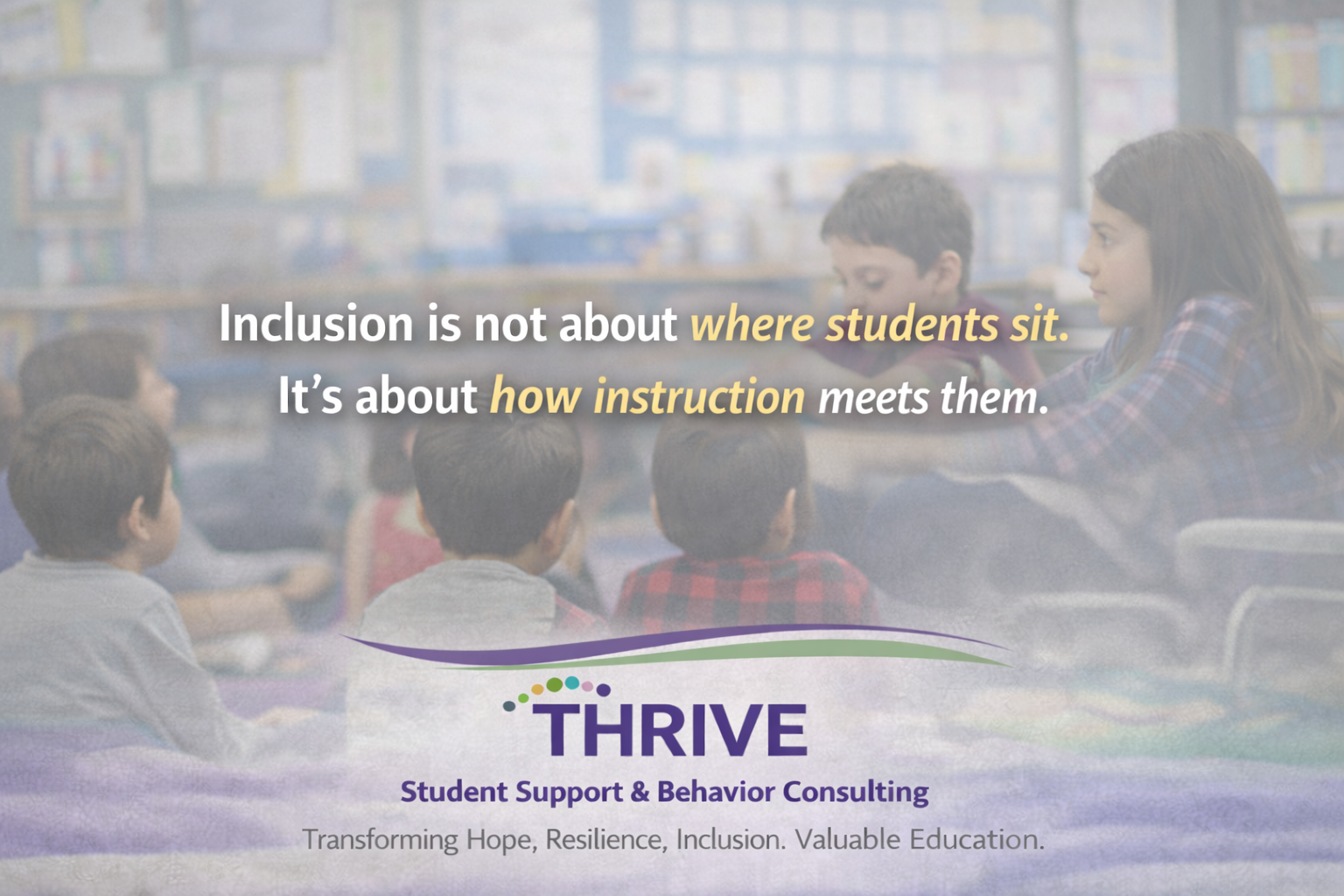
General education settings should not be the end-all be-all simply because a student is physically present in the room. True inclusion is measured by access to learning, not proximity to peers.
When instruction is rigid, developmentally mismatched, or heavily language-loaded without adequate supports, even well-intentioned inclusive environments can become exclusionary in practice. Students may comply outwardly while disengaging internally, or express distress through behavior that is then misinterpreted as defiance.
This is especially evident in early learning and primary grades, where children are still developing foundational skills in regulation, communication, and executive functioning.
Strong early learning programs do not ask children to adapt to instruction.
They adapt instruction to children.
That is where engagement, regulation, and meaningful learning begin.
Engagement and Regulation Are Instructional Outcomes
Behavior is communication. Engagement is not a personality trait. Self-regulation is not a prerequisite skill that children must “have” before learning can occur.
Research consistently shows that environments designed with flexibility, predictability, and multiple pathways to participation benefit all learners, not just students with identified disabilities.
Effective systems prioritize instructional practices that support regulation and engagement as part of core instruction, including:
1. Developmentally Responsive Instruction
Instruction aligned to developmental readiness reduces cognitive overload and frustration. This includes appropriate pacing, concrete learning experiences, and opportunities for movement and exploration, especially in early grades.
2. Universal Design for Learning (UDL)
UDL frameworks emphasize multiple means of engagement, representation, and expression. When students can access content visually, auditorily, and kinesthetically, engagement increases and behavior concerns often decrease.
3. Predictable Routines and Visual Supports
Consistent routines paired with visual schedules and clear expectations support self-regulation by reducing uncertainty and cognitive demand. These supports benefit all students, including those with anxiety, language differences, or trauma histories.
4. Relationship-Centered Classrooms
Strong adult-student relationships are one of the most powerful protective factors for engagement and behavior. Responsive interactions, co-regulation, and emotional safety are foundational to learning.
5. Play-Based and Experiential Learning
Play, hands-on exploration, and collaborative learning are not extras. They are evidence-based strategies that support language development, executive functioning, and self-regulation, particularly in early childhood settings.
When Systems Adjust, Students Succeed
When schools see widespread disengagement or behavioral challenges, the question should not be, “What’s wrong with these students?”
The better question is, “What is this pattern telling us about our instruction, expectations, and environments?”
Inclusion works when instruction is flexible. Behavior improves when regulation is supported. Learning accelerates when access is real.
Teaching the way children learn is not lowering standards. It is designing systems that recognize how learning actually happens.
And that is the work of leadership.
References and Supporting Research
CAST. (2018). Universal Design for Learning Guidelines version 2.2.
https://udlguidelines.cast.org
Center on the Social and Emotional Foundations for Early Learning (CSEFEL). (n.d.). Promoting social emotional competence.
https://challengingbehavior.cbcs.usf.edu
National Association for the Education of Young Children (NAEYC). (2020). Developmentally Appropriate Practice Position Statement.
https://www.naeyc.org/resources/position-statements/dap
National Academies of Sciences, Engineering, and Medicine. (2019). Shaping Summertime Experiences: Opportunities to Promote Healthy Development and Well-Being for Children and Youth.
https://nap.nationalacademies.org
Sugai, G., & Simonsen, B. (2012). Positive behavioral interventions and supports: History, defining features, and misconceptions. PBIS.org.
https://www.pbis.org